
It starts with what's there already
Removing an existing lawn is rarely as simple as stripping turf. Under most Newcastle gardens is a mix of topsoil, clay and whatever the original developer left behind, and all of it has to come out to a workable depth before a base can go in. A garden with heavy clay or poor natural drainage needs a deeper, more carefully compacted sub-base than one with light, free-draining soil, and that difference shows up directly in the labour and materials cost.
Access is the other early factor. A rear garden reached only through the house or down a narrow side passage means every barrow load of spoil out and every bag of sub-base in is moved by hand, which adds real time to even a modestly sized lawn.
Base depth and drainage
Artificial grass needs a free-draining, compacted sub-base underneath a shock/geotextile membrane, typically built up to a depth suited to the ground conditions — more on clay, less on already free-draining soil. Skipping this and laying turf straight onto levelled soil is the single biggest cause of the two complaints we hear about cheap installs: puddling after rain and the surface going lumpy as the ground settles underneath it.
Where a garden already struggles with standing water, that drainage work is doing double duty — solving a problem that existed with the real lawn as well as preparing a base for the artificial one.
- Excavation depth and spoil removal
- Compacted permeable sub-base
- Geotextile membrane for weed suppression and stability
- Edging or restraint at every boundary
- Drainage provision on heavy clay or low-lying gardens
Pile height, density and backing
Artificial grass products vary a good deal in pile height, density (how many stitches per metre) and backing quality. A shorter, denser pile in the 26–30mm range tends to hold its shape better under regular foot traffic and furniture than a longer, showier pile, which can look flattened within a season in high-use areas. Better products also use a more UV-resistant yarn, which matters for colour retention through several Newcastle summers even if they are shorter than some.
Backing quality affects both drainage rate and lifespan. A cheap, thin backing is more likely to degrade or tear under repeated foot traffic than a heavier, properly perforated backing designed for outdoor use.
Edging and detailing
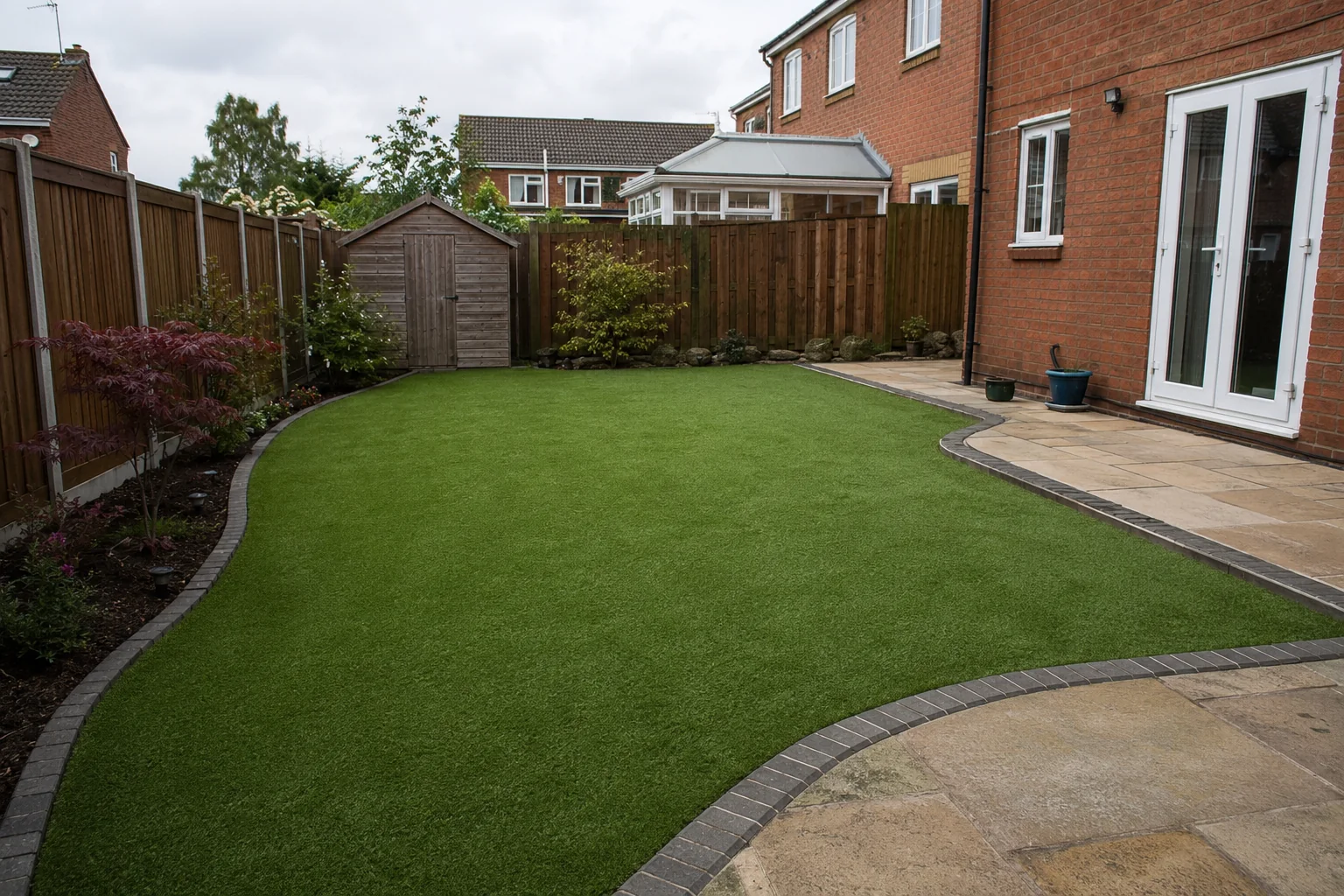
A neat, secure edge against a patio, border or fence line is what stops artificial grass looking like an obvious retrofit. That usually means a timber or composite edging board, or a run of block or brick edging where the lawn meets paving, pinned down properly so the grass has something to key into rather than just being trimmed and left loose.
Curved borders, island beds and awkward corners around trees or manholes all add cutting time in the same way they do with block paving, and are worth mentioning when you're getting quotes compared.
Typical cost bands, supplied and fitted
As a rough guide for a typical North East garden with reasonable access, budget-tier artificial grass installs sit at the lower end of the market, mid-tier products with a proper sub-base and edging sit noticeably above that, and premium, dense, UV-stable products with more involved base work or drainage sit higher again. The final figure moves with garden size, ground conditions, access and how much cutting the shape demands, so treat any headline per-square-metre price as a starting point rather than a fixed quote until the garden has been seen.
Small garden vs large garden effects
Smaller gardens carry a higher cost per square metre because setup, base preparation and edging costs are largely fixed regardless of area — a compact courtyard lawn has almost as much edging relative to its size as a large lawn has proportionally less. Larger lawns spread those fixed costs further, which is why the per-metre price on a big rear garden is usually more favourable than on a small one, even though the total is higher.
Ongoing cost vs a real lawn
A real lawn has a lower up-front cost but an ongoing one: mowing, feeding, weed treatment, reseeding bald patches, and the odd professional scarify or aerate. Artificial grass has a higher up-front cost and a much lower ongoing one — occasional brushing to keep the pile upright, an annual rinse or light clean, and topping up infill on some products every few years. Over a long enough period the running costs of a real lawn narrow the gap, but most people choosing artificial grass are doing it for time and appearance rather than a strict payback calculation.
Questions worth asking any installer
A written quote should tell you the sub-base depth and material, whether a membrane is included, the pile height and density of the product, whether the backing is perforated for drainage, and how the edges will be restrained. If a quote is unusually cheap, it is worth asking specifically what has been left out of that list, because it is almost always one of these.
Frequently asked questions
How long does artificial grass last?+
A reasonable-quality product properly installed on a correct base typically performs well for well over a decade, though pile appearance in heavy-use areas will wear faster than in a lightly used border.
Does artificial grass drain properly in heavy rain?+
It should, provided the backing is perforated and the sub-base underneath is genuinely free-draining. On heavy clay gardens, additional drainage provision in the base is often needed to stop water sitting underneath.
Can artificial grass go over an existing lawn without digging it out?+
Not properly. The existing turf and topsoil need removing so a compacted sub-base can be built; laying straight over soil leads to settling and an uneven surface.
Does artificial grass get hot in summer?+
It can feel noticeably warmer than real grass in direct summer sun, though this is a shorter-lived issue in the North East than in warmer parts of the country.
Is artificial grass pet-friendly?+
Most modern products are, with a permeable backing that lets liquid through to the base rather than pooling. Regular rinsing helps keep it fresh where pets use the lawn heavily.
Can I mix artificial grass with real planting borders?+
Yes, and it's a common combination — artificial grass for the low-maintenance lawn area, with real borders, pots or a small planted bed kept for interest and softness.
Get a realistic figure for an artificial lawn
Tell us your garden's rough size and access, and we'll talk through base requirements and product options before putting a written quote together.