
Indian Sandstone Patios for Gosforth Gardens
Riven Indian sandstone suits Gosforth's 1930s housing stock, and sealing it properly is what keeps the colour looking right through a North East winter.
Gosforth's mix of 1930s semis and generous gardens has always suited a natural stone patio better than a harder, more industrial material, and sandstone remains the most requested surface on the streets off Salters Road and Christon Road.
Because it's a quarried natural stone rather than a manufactured tile, sandstone behaves differently to porcelain both during laying and afterwards — particularly in how its colour reacts to weather and sealing.
A lot of the sandstone patios we get called out to repair in Gosforth were never sealed at all, or sealed with the wrong product, so the stone has picked up staining and uneven colour over a few winters.
No deposit needed · 10-year guarantee · Mon–Fri 8am–6pm
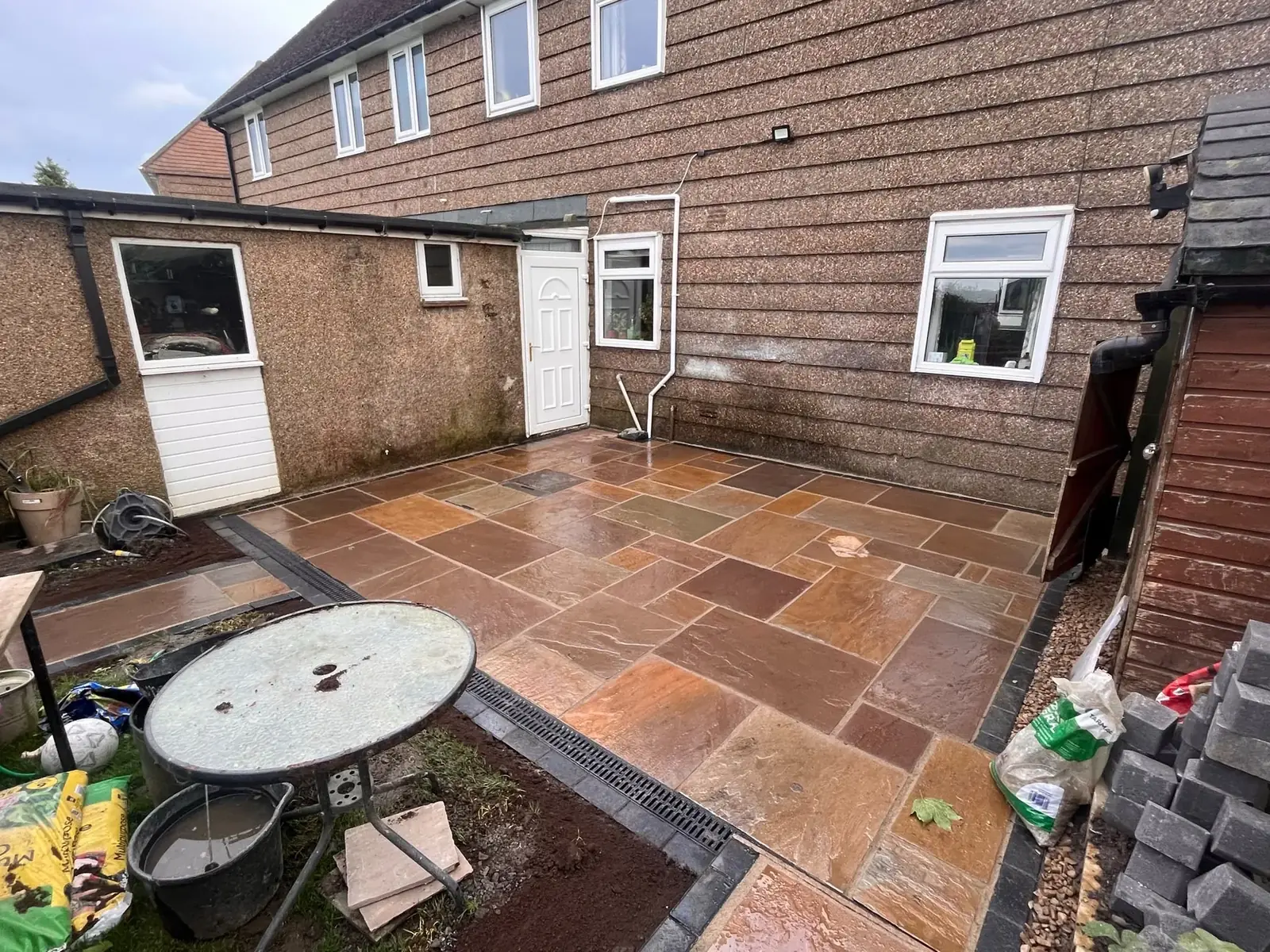
Why sandstone's colour moves and what sealing actually does
Indian sandstone is naturally porous, and its surface colour deepens and lightens depending on moisture content — a wet sandstone patio always looks richer than a dry one. Left unsealed, that same porosity lets in dirt, algae and tannins from nearby planting, which stain unevenly rather than washing off.
A breathable sandstone sealer reduces how much water and staining the stone absorbs while still letting moisture escape from underneath, so you keep a more even, predictable colour without trapping damp in the slab.
Riven vs sawn sandstone for a 1930s semi
Riven sandstone has a natural, slightly undulating textured surface, which tends to sit better with the brick and render of Gosforth's older semis. Sawn or fully calibrated sandstone gives a flatter, more contemporary look. We'll usually recommend riven for a period property and sawn where the extension or garden design is more modern.
Working around dropped-kerb and frontage conversions
A number of Gosforth's deep front gardens are being converted to off-street parking for the first time, which sometimes runs alongside a rear patio project on the same visit. Where a dropped-kerb application to Newcastle City Council is involved, that approval needs to be in place before we touch the frontage, even if the rear patio work can start independently.
Gosforth facts
- Postcode area
- NE3
- Housing character
- 1930s semis with generous front gardens
- Distance from the city centre
- About 3 miles
- Nearest road
- A189 Great North Road
Get a sandstone patio quote for Gosforth
Tell us whether you're leaning riven or sawn and we'll bring samples to a site visit.
No deposit needed · 10-year guarantee
Natural stone needs a different approach to porcelain
Getting the sealing and stone type right is what keeps a Gosforth sandstone patio looking good well past its first winter.
Questions we get asked in Gosforth
Does sandstone need sealing straight away?+
We usually let a new patio cure for a few weeks before sealing, following the sealer manufacturer's guidance, rather than sealing over slabs that are still drying out.
What's the difference between riven and sawn sandstone?+
Riven has a natural textured surface with slight thickness variation; sawn or calibrated sandstone is cut flat and consistent, giving a more uniform contemporary look.
Will sealing make the patio slippery?+
A correctly specified breathable sealer shouldn't reduce slip resistance noticeably — we avoid glossy indoor-style sealers for exactly this reason.
Can you do the rear patio before my dropped kerb is approved?+
Generally yes, as they're separate pieces of work, though we'll sequence deliveries sensibly if both are happening around the same time.