
Porcelain Patios on Kingston Park's Executive Estates
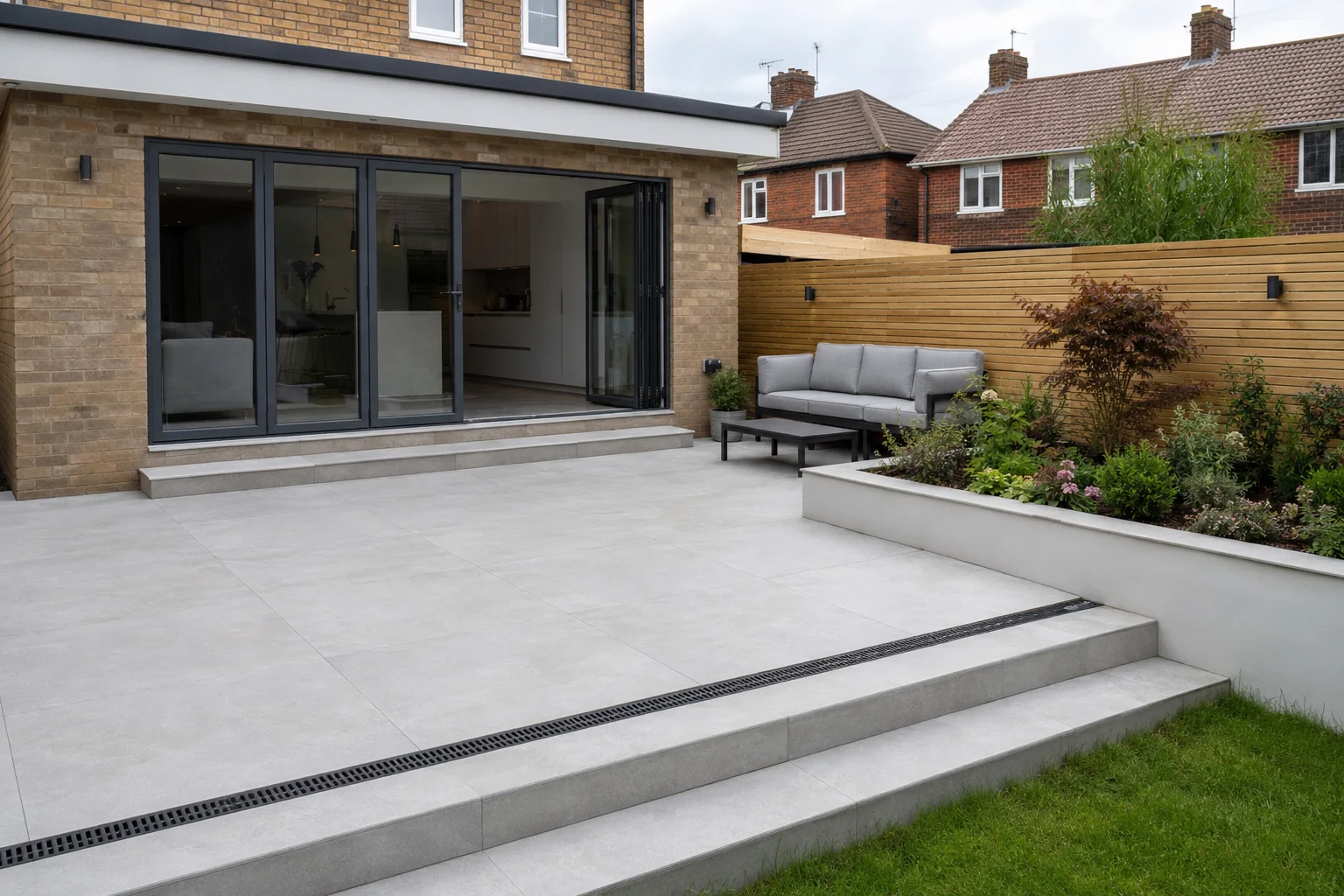
Kingston Park's newer housing suits a clean porcelain finish — done properly, with jointing that's built to last rather than brushed-in as an afterthought.
The executive estates around Brunton Lane and Meadowfield Drive were built to a consistent modern standard, and porcelain suits that look far better than a heavily textured stone would.
Where we see problems on estates like this, it's almost always in the jointing — either brushed-in sand and cement that's washed out within a season, or a compound applied in the wrong conditions that never fully cures.
This page covers our porcelain jointing approach specifically; we've written separately about sandstone patios and general patio installation in Kingston Park, since the ground and detailing issues differ between the three.
No deposit needed · 10-year guarantee · Mon–Fri 8am–6pm
Why brush-in mortar jointing fails on porcelain
Dry brush-in mortar relies on rainwater slowly hydrating the joint after it's swept in. On a dense, low-absorption porcelain tile with tight, consistent joints, that water often can't get in evenly, so parts of the joint never cure properly and start crumbling or washing out within a year.
We use a pre-mixed or slurry jointing compound worked into the joint with a squeegee and finished by hand, which cures as one consistent block rather than relying on rain to activate it.
Management-company rules on some Kingston Park plots
A number of the newer developments here have management-company covenants covering changes to the frontage and, on some plots, the rear garden too. Where this applies we ask to see the relevant document before starting design work, so the finished patio doesn't need retrospective approval.
Consistent joint width across a calibrated tile
Because calibrated porcelain is a fixed thickness, we can run a genuinely consistent joint width across the whole patio using spacers during laying, rather than eyeballing gaps — which is part of what gives a finished porcelain patio its clean, uniform look.
Kingston Park facts
- Postcode area
- NE3
- Character
- Newer executive estates and consistent modern housing
- Distance from the city centre
- About 5 miles
- Nearest Metro
- Kingston Park Metro station
The joint is the part that fails first
A porcelain patio lives or dies by its jointing — get that detail right and the rest of the installation looks after itself for years.
Ask us about porcelain jointing in Kingston Park
If your existing patio has washed-out joints, we can quote for a proper porcelain re-lay rather than a patch repair.
No deposit needed · 10-year guarantee
Questions we get asked in Kingston Park
Why did my old brushed-in joints wash out?+
Dry brush-in jointing depends on rain slowly hydrating the mix, and on tight porcelain joints that often doesn't happen evenly, so the joint never fully cures and starts to crumble.
Do I need to check anything with my management company first?+
If your development has a management company covering the frontage or garden, check whether patio work needs notifying before we start — we're happy to wait for that confirmation.
Can jointing be done in cold weather?+
We follow the compound manufacturer's temperature guidance and won't apply jointing in conditions likely to cause it to fail, rescheduling if needed.
Is porcelain jointing different from block paving jointing?+
Yes — block paving typically uses kiln-dried sand or a polymeric sand in narrow joints, while porcelain patios use a mortar-based or slurry compound in wider joints, which behave quite differently.