
Lap and overlap panels
Pre-made panels of thin overlapping boards are the most familiar garden fence. They are quick to fit and give good privacy. The trade-off is that the thin boards and lightweight frames are the most vulnerable to strong wind, and a single damaged panel can look obvious against its neighbours.
Closeboard (featheredge)
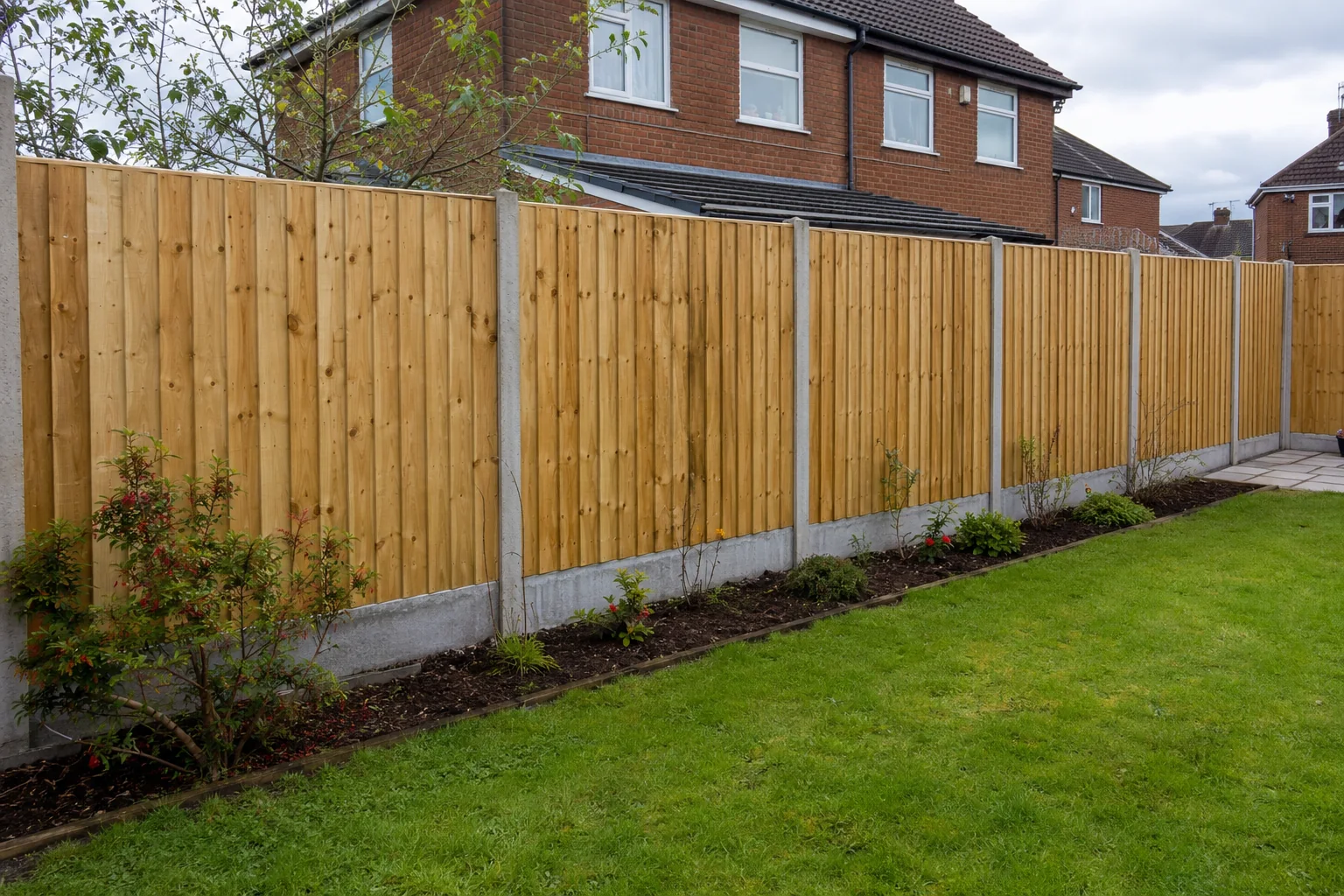
Closeboard is built on site from vertical featheredge boards nailed to horizontal rails between posts. It is sturdier than panel fencing and individual boards can be replaced if one is damaged. For many gardens it is the best balance of strength, privacy and appearance.
Slatted and contemporary styles
Horizontal slatted fencing gives a modern look and pairs well with porcelain patios and clean-lined gardens. Small gaps between slats let some wind pass through, which reduces the load on the posts. Privacy is slightly lower, depending on gap width.
Picket and low front fencing
Low picket or rail fencing marks a front boundary without blocking the view of the house. Height limits for fences next to a road are lower than in back gardens, which is worth knowing before choosing a style for the front.
Timber posts or concrete posts
Posts are where most fences fail. Timber posts set in the ground are prone to rot at the point where they meet the soil, particularly in wet, heavy ground. Once a post rots, the fence leans.
Concrete posts with gravel boards do not rot, and panels slot into them, so a damaged panel can be swapped without disturbing the post. They are a popular choice for longevity. Timber posts remain a good fit for closeboard and some decorative styles, provided they are pressure-treated and set properly.
- Concrete posts: longest life, panels easily replaced
- Timber posts: warmer look, suit closeboard, need good treatment
- Gravel boards: keep timber off the soil and extend fence life
Height, boundaries and neighbours
Garden fences are generally limited to around two metres at the rear and one metre next to a highway without needing permission. It is always worth confirming which boundary is yours and talking to neighbours before work starts.
Fitting fencing alongside other work
If you are also planning a patio or artificial grass, putting the fence in first avoids digging post holes next to new paving or turf. We often do boundary and surfacing work as one job for that reason.
Matching the fence to the garden
Start with what the fence has to do. If privacy is the priority, closeboard or overlap panels give a solid screen. If the garden faces the prevailing wind, a sturdier build on concrete posts, or a slatted design that lets some air through, will stand up better over time. For a front garden, a lower, more open fence keeps the house visible and stays within height limits.
Think about the rest of the garden too. A contemporary slatted fence sits naturally with porcelain paving and clean lines, while traditional closeboard suits cottage-style planting and natural stone. Colour matters as well: darker stains make planting stand out, lighter finishes brighten a small or shaded space.
Budget is the last piece. Panel fencing is usually the quickest to install, while closeboard and slatted styles take more labour on site. We price each job once we have seen the boundary, the ground and how much of the old fence needs removing, and you get a fixed written figure with No Deposit Needed.
Frequently asked questions
What is the strongest fence style?+
Closeboard on well-set posts is among the sturdiest for everyday gardens.
Should I choose concrete posts?+
They do not rot and make panel replacement simple, which suits exposed or damp gardens.
Do you remove the old fence?+
Yes, removal and disposal are included in the quote unless you want to keep it.
Do you need a deposit?+
No Deposit Needed — you pay when the fence is up.
Get a fencing quote
We will look at the boundary and ground and give you a written price. Call 0191 743 3072.